Businesses & households in Rivervale rely on consistent hot water performance. Knowing when to repair a system versus when to invest in a replacement is essential for cost control, reliability & long-term efficiency. We outline the lifespan expectations of major system types, the cost thresholds that guide replacement decisions, and the operational signs that indicate a system is approaching failure.
Typical Lifespans by System Type
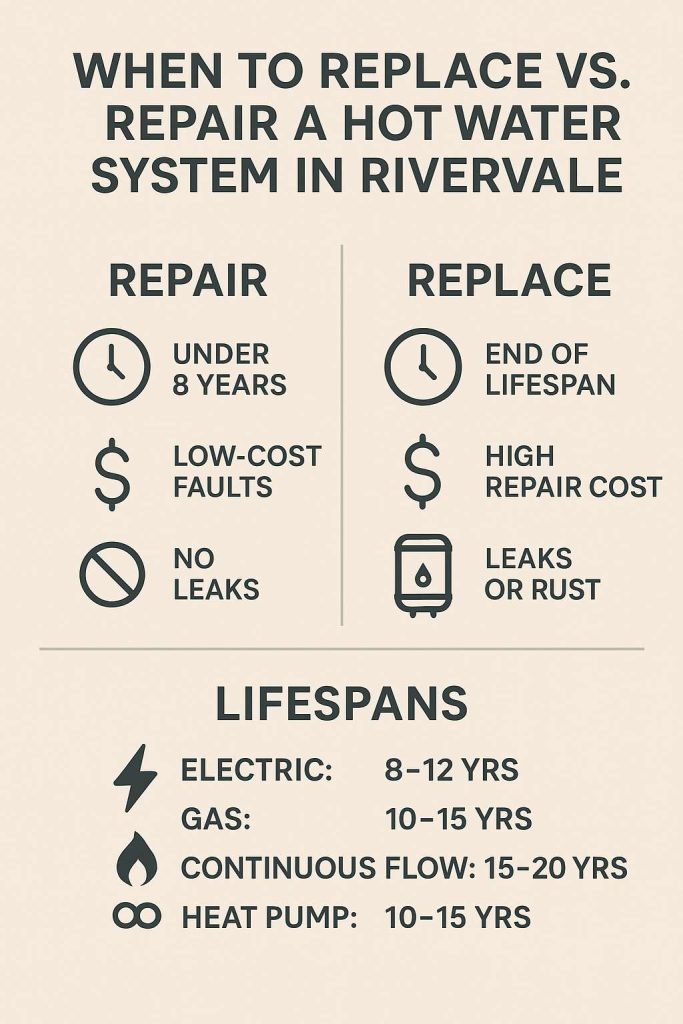
Understanding expected lifespan helps determine whether repair spending is justified.
Electric Storage Systems
Electric storage units generally last 8–12 years. When failures occur after the 10-year mark, repairs become less cost-effective due to ageing tanks, rust risk & declining efficiency.
Gas Storage Systems
Gas storage units operate for 10–15 years. Burner issues are typically repairable early in life, but tank corrosion or repeated ignition failures beyond 12 years often signal replacement time.
Continuous Flow (Gas or Electric)
Continuous-flow systems can last 15–20 years, thanks to tankless operation. However, heat exchanger faults & sensor failures late in life require costly part replacements, which may justify a new system.
Heat Pump Hot Water Systems
Heat pumps achieve 10–15 years of performance. Compressor failure near the end of life normally results in replacement due to the high price of major components.
Cost Thresholds: Repair vs. Replace
A practical cost benchmark helps prevent overspending on an ageing unit.
When Repair Makes Sense
Repairs are usually worthwhile when:
- The system is under 8 years old
- Repair costs are less than 25–30% of the price of a new unit
- Issues are limited to thermostats, elements, valves or igniters
- No tank corrosion or performance decline is present
When Replacement Is More Cost-Effective
Replacement becomes the better decision when:
- The system is near or beyond its lifespan
- Repairs exceed 40–50% of the replacement cost
- Multiple components are failing in succession
- Hot water recovery times are dropping
- There are recurring leaks, rust, or pressure problems
Common System Problems & What They Indicate
Leaks Around the Tank
A leaking storage tank almost always requires replacement because structural failures cannot be repaired.
Inconsistent Water Temperature
If caused by a thermostat or heating element, repair is feasible. If temperature issues stem from ageing tanks or worn heat exchangers, replacement is the better long-term option.
Rising Energy Bills
A system consuming more power or gas than usual indicates efficiency loss. Late-life inefficiency is a strong indicator for replacement.
Excessive Noise
Popping or rumbling in storage tanks points to sediment buildup. Flushing may help, but older tanks with heavy sediment accumulation typically warrant replacement.
Choosing the Right Replacement System
When replacement is necessary, selecting a suitable model ensures long-term value.
Storage vs Continuous Flow
Storage systems suit high-demand households with simultaneous use. Continuous-flow units offer ongoing efficiency and unlimited hot water but need proper sizing.
Gas, Electric, or Heat Pump
Gas provides fast recovery, electric offers simplicity, and heat pumps deliver long-term efficiency for lower running costs.
Local Considerations for Rivervale
Rivervale homes often have mixed system types due to varying block sizes & renovation histories. Working with a Rivervale Plumber who understands local system demands helps ensure correct assessments & installations. A specialist Hot water Plumber Rivervale can provide accurate cost comparisons, performance assessments & compliant replacements tailored to local property conditions.
Conclusion
The decision to repair or replace a hot water system depends on unit age, repair cost percentage, system type & long-term operating performance. Repairs are suitable for younger units with minor issues, but ageing systems nearing end of life become more expensive to maintain & less efficient to operate. Replacement at the right time ensures predictable costs, reliable supply & improved household efficiency.
