
Commercial heat pump hot water systems are increasingly considered across offices, hospitality venues, gyms, childcare centres, strata complexes, and light industrial sites where hot water demand is steady, predictable, or rising. In Rivervale, the decision typically comes down to measurable performance (energy use, recovery times, peak handling) versus ongoing maintenance requirements (service intervals, parts, downtime risk) compared with gas storage, continuous flow, or electric resistance systems.
Performance comparison: what changes after the upgrade
Energy efficiency (running cost driver)
Commercial heat pumps move heat rather than generating it directly. In most real-world commercial applications, that translates to lower electricity consumption per litre of hot water than electric resistance storage. Compared with gas systems, the outcome depends on tariff structure, operating hours, and whether the site can shift heating to off-peak periods or align with solar PV output.
Recovery time & peak demand handling
Gas storage often recovers quickly and can be strong on sharp peaks. Heat pumps can also perform well, but they rely more heavily on correct sizing of storage volume, staged heating, and demand planning. If a site has short, intense draw-offs (for example, multiple showers within a narrow window), a heat pump solution is usually designed around larger storage, multiple modules, or pre-heat strategies to avoid temperature drop.
Temperature stability at outlets
Heat pump systems can provide stable outlet temperatures when paired with suitable storage, tempering valves, and circulation design. Where sites run recirculation loops, good controls matter: maintaining loop temperature without constant reheating is a major factor in overall efficiency.
Ambient temperature sensitivity
Heat pumps typically perform best when ambient air temperatures are moderate. Performance can dip during colder spells, so commercial designs often include staging, backup elements, or conservative capacity margins to protect recovery times when conditions are less favourable.
Noise, footprint, and placement
Heat pumps need airflow & appropriate clearances. They can reduce plantroom gas infrastructure, but they introduce outdoor or semi-outdoor equipment placement considerations (noise, neighbour proximity, service access, condensate management).
Maintenance comparison: heat pumps vs conventional commercial systems
Routine servicing profile
Gas systems commonly focus on burner operation, flue integrity, combustion safety checks, and water-side scale management. Heat pumps shift a portion of the maintenance focus to refrigeration and air-side components: coil cleanliness, fan operation, defrost behaviour (where applicable), condensate drainage, and controller performance.
Water quality & scale risk
All hot water systems suffer if water quality is poor, especially at higher storage temperatures. Heat pumps still require scale control and, depending on design, may need periodic inspection of storage tanks, tempering valves, strainers, and sacrificial anodes. A consistent water treatment approach can reduce call-outs and extend component life across any system type.
Parts, uptime, and operational risk
Gas systems can be straightforward to repair with widely available components, depending on model. Heat pump systems are reliable when installed & maintained correctly, but repairs may involve specialised parts (compressors, control boards) and refrigeration expertise. For sites where hot water is business-critical, modular heat pump arrays (rather than a single large unit) can reduce downtime risk by maintaining partial operation during a fault.
Controls & monitoring
Heat pumps benefit strongly from correct controls: scheduling, setpoints, anti-legionella cycles, recirculation management, and fault alerting. With basic monitoring in place, many issues are identified earlier, which can lower emergency call-outs and protect service continuity.
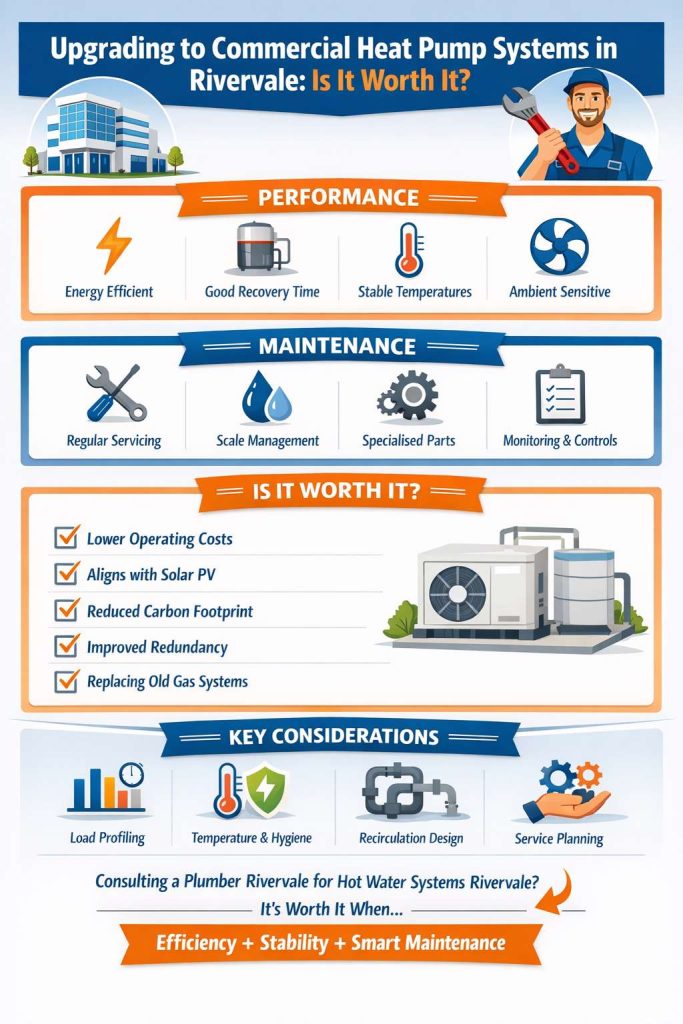
What “worth it” usually means in commercial Rivervale settings
A commercial heat pump upgrade is typically worthwhile when we can clearly meet at least two of the following outcomes:
1) Lower operating costs through efficiency
If the site runs hot water for long hours and electricity pricing supports it (including controlled-load or favourable time-of-use windows), heat pumps often improve cost predictability.
2) Better alignment with solar PV
Sites with daytime demand and solar generation can get stronger value by converting more hot water energy to self-consumed electricity.
3) Reduced carbon exposure
For organisations tracking emissions, electrification can simplify reporting and reduce reliance on combustion-based equipment.
4) Improved redundancy through modular design
Multiple heat pump modules with shared storage can improve business continuity compared with a single-point-of-failure plant.
5) Plant upgrades or compliance-driven replacement
If a gas system is nearing end-of-life, has recurring faults, or faces site constraints (flueing issues, ventilation limitations), the business case can shift quickly in favour of electrified options.
Operational considerations before committing
Load profiling (the non-negotiable step)
The most common cause of disappointing outcomes is mismatch between actual usage patterns and system design. Understanding when hot water is used (morning peaks, lunchtime spikes, evening demand) guides storage sizing, staging, and control scheduling.
Temperature setpoints, tempering, and hygiene cycles
Commercial sites must maintain safe delivery temperatures while supporting hygiene requirements. Heat pump systems may use periodic high-temperature cycles or supplementary heating to support disinfection strategies, so controls must be configured for both safety and efficiency.
Recirculation loops
Recirculation is often essential in commercial buildings, but it can quietly drive energy use. The quality of insulation, balancing, pump controls, and return temperatures can make or break efficiency gains after a heat pump upgrade.
Service access & lifecycle planning
A heat pump plant should be accessible for coil cleaning, fan service, and component replacement. Planning for expected service intervals and keeping an asset register of key components supports predictable maintenance budgeting.
Practical decision guide for Rivervale businesses
If the site has consistent daily hot water use, enough space for storage, and the ability to schedule heating intelligently, a heat pump upgrade can deliver strong whole-of-life value. Where demand is extremely peaky with minimal storage tolerance, gas or hybrid solutions may remain competitive unless the design incorporates adequate storage & modular capacity. In all cases, engaging a qualified Plumber Rivervale early ensures the load profile, recirculation design, and compliance settings are established before equipment is selected. When we scope a commercial upgrade for Hot water Systems Rivervale, we prioritise measured demand, redundancy, and serviceability so performance gains hold up over the full lifecycle, not just at commissioning. For businesses comparing options, a second review by a Plumber Rivervale can also validate assumptions around downtime risk, spare parts strategy, and maintenance access. A well-designed heat pump plant for Hot water Systems Rivervale is usually “worth it” when it reduces operating cost volatility while maintaining stable delivery temperature across peak periods with a maintenance plan aligned to the site’s operating hours.
