Hot water infrastructure is a critical operational asset across multiple industries. When systems fail, the consequences extend far beyond inconvenience, directly affecting productivity, compliance, customer satisfaction, and revenue continuity. In sectors such as hospitality and manufacturing, downtime from hot water system failures translates into measurable financial loss, operational disruption, and reputational risk.
This article examines how downtime impacts these sectors, quantifies the associated costs, and outlines why proactive system planning is essential for commercial continuity.
Why Hot Water Downtime Carries High Economic Risk
Hot water systems support essential business functions including sanitation, food preparation, cleaning, production processes, and staff welfare. A system failure often triggers immediate operational restrictions, forcing businesses to reduce output or cease operations altogether.
Downtime costs are typically divided into four categories:
- Lost revenue from halted or reduced operations
- Labour inefficiencies and idle workforce costs
- Compliance breaches and regulatory penalties
- Secondary reputational and contractual impacts
In high-volume environments, even short outages can produce disproportionate financial consequences.
Hospitality Sector: Revenue Loss & Compliance Exposure
Hotels, restaurants, cafés, and commercial kitchens rely on consistent hot water availability to meet hygiene standards and customer expectations. A failure often results in immediate service limitations or full closure.
Quantifying the loss
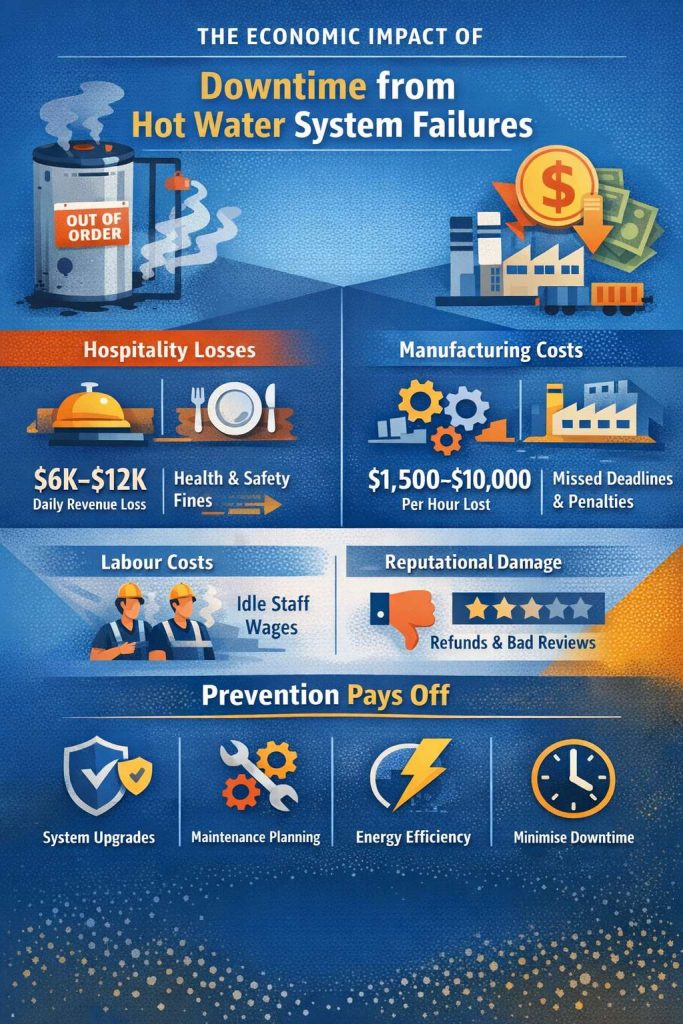
A mid-sized hospitality venue serving 120–150 customers per day can generate between $6,000 and $12,000 in daily turnover. A single day without hot water may result in:
- Complete closure due to health regulations
- Staff being sent home or paid while idle
- Cancelled bookings and refunds
- Long-term customer attrition
For accommodation providers, the impact compounds further. Guests expect uninterrupted access to hot water, and failure often leads to refunds, negative reviews, and reputational damage that persists beyond the outage period.
From a compliance standpoint, food safety authorities require strict sanitation standards. Operating without adequate hot water exposes businesses to enforcement action, fines, or licence suspension.
This is why many operators treat system reliability as a commercial risk management issue rather than a maintenance concern.
Manufacturing Sector: Production Delays & Contractual Risk
In manufacturing environments, hot water systems are often integrated into production processes, equipment cleaning, chemical treatments, and temperature-controlled workflows. Failure can interrupt entire production lines.
Operational cost exposure
Manufacturing downtime is typically calculated per hour rather than per day. Depending on the operation, costs may range from:
- $1,500 to $10,000 per hour in lost output
- Overtime costs to recover production schedules
- Missed delivery deadlines and contract penalties
In regulated industries such as food manufacturing, pharmaceuticals, and industrial processing, hot water failures can also invalidate quality assurance protocols, resulting in wasted materials or rejected batches.
Downtime in these settings often triggers a cascading effect where delays compound across supply chains, increasing indirect financial exposure well beyond the initial outage.
Labour & Workforce Inefficiency Costs
Across both sectors, staff productivity losses are frequently underestimated. Employees unable to perform their duties still represent a fixed cost, particularly in award-regulated or unionised environments.
For example:
- Hospitality staff sent home still incur minimum shift payments
- Manufacturing crews may be paid while equipment is offline
- Supervisory staff diverted to crisis management rather than core operations
These inefficiencies add to the true cost of downtime but are often omitted from surface-level assessments.
Why Preventative Planning Outperforms Reactive Repair
Emergency repairs typically carry premium costs, delayed parts availability, and rushed decision-making. In contrast, planned system upgrades and staged replacements offer predictable expenditure and reduced operational risk.
Businesses that invest in scheduled upgrades, capacity assessments, and redundancy planning consistently experience lower lifetime system costs and fewer operational interruptions. This is particularly relevant when considering Hot Water System installations Rivervale, where many commercial facilities operate with ageing infrastructure under increasing demand loads.
Modern systems provide:
- Higher recovery rates
- Improved energy efficiency
- Better compliance alignment
- Reduced failure frequency
Long-Term Financial Exposure & Asset Strategy
When evaluating system reliability, businesses should assess not only repair costs but also lost opportunity costs and risk exposure. A single major failure can exceed the cost of replacement when downtime, labour loss, and reputational impact are factored in.
Organisations operating in Rivervale and similar commercial zones increasingly view hot water system Rivervale reliability as a strategic asset decision rather than a reactive maintenance issue.
Conclusion
Downtime from hot water system failures imposes measurable and often severe economic consequences across hospitality and manufacturing sectors. Lost revenue, labour inefficiencies, compliance risks, and reputational damage combine to create financial exposure far greater than the cost of preventative investment.
Businesses that quantify downtime risk, plan upgrades proactively, and treat hot water infrastructure as a core operational asset are better positioned to maintain continuity, protect revenue, and meet regulatory expectations in competitive commercial environments.
